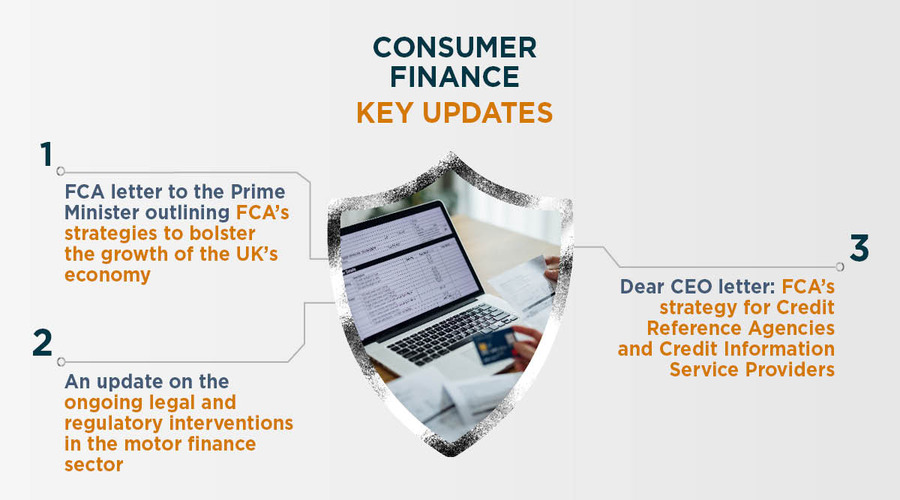
1. FCA policy statement on further temporary changes to handling rules for motor finance complaints
On 19 December 2024, the Financial Conduct Authority (FCA) published a policy statement (PS24/18) on further temporary changes to handling rules for motor finance complaints. This follows the FCA's consultation in November 2024 pursuant to the CoA's judgment in the Johnson v FirstRand case. The relevant firms sought permission to appeal to the Supreme Court, which has been granted.
The FCA had previously made changes to its Dispute Resolution: Complaints (DISP) rules in relation to motor finance Discretionary Commission Arrangements (DCA) complaints; the FCA is now seeking to apply the same changes to motor finance non-DCA complaints which was also subject to the CoA judgment. The FCA is therefore granting firms additional time to address complaints related to motor finance agreements that do not involve DCAs.
Without these changes, firms would have 8 weeks to acknowledge, investigate and provide a final, substantive response to motor finance non-DCA commission complaints. Therefore, similar to its DCA intervention the aim is to help prevent disorderly, inconsistent and inefficient outcomes for consumers and firms in relation to motor finance non-DCA commission complaints.
Further, given the Supreme Court's permission to appeal the CoA's decision the FCA is finalising the extension to ensure that firms are able to consider the outcome of this appeal before responding to the relevant complaints.
The complaint handling extension came into force on 20th December 2024.
What are the changes?
The changes in DISP sourcebook broadly mirror the existing rules for motor finance DCA commission complaints:
- Additional time for firms to send final response- Specifically, firms now have until 4 December 2025 to issue a final response to non-DCA complaints which were made on or after 26 October 2024 i.e., complaints that were received less than 8 weeks before 20th December when rules came into force where a final response hasn't been sent.
- Additional time for consumers to refer complaints to the Financial Ombudsman Service (FOS)- Consumers, upon receiving a final response, have until either 15 months from the date the final response is issued or 29 July 2026, whichever is later, to consider referring their complaint to FOS.
- Record keeping and communication- The rules also require firms to maintain and preserve relevant records for a period of 3 years (excluding the period of the extension) and to communicate to relevant complainants about the extension to the time limits.
- Obligations to progress complaints under DISP remain unchanged- The rules do not remove the obligations on firms to progress complaints under the DISP rules, i.e., continuing to investigate and collect evidence to help with the eventual resolution of these complaints.
The FCA has confirmed that the update it intends to provide in May 2025 on its next steps in its review of DCAs will depend on the progress of the appeal to the Supreme Court.
2. FCA expectations of firms on communicating with motor finance customers about commission
On 19 December 2024 the FCA also published a guidance setting out its expectations of firms communicating with motor finance customers about commission in light of the ongoing litigations in this area.
The FCA re-iterates the CoA ruling that merely disclosing the commission is not enough; consumers must be fully informed about all material facts, including the commission's existence, calculation, and amount. The Court emphasised that material facts must be clearly communicated to consumers, and simply including them in the fine print is insufficient.
To help firms navigate this current state of law, the FCA highlights the importance of clear communication with customers to enable them to make an informed decision. The FCA makes a link to the Customer Understanding outcome under Consumer Duty and reminds firms that this outcome is of particular relevance to the CoA judgment, given the focus on consumer disclosure and consent.
The guidance sets out some key themes for firms in communicating with motor finance customers about commission:
Engaging communications
- Firms' communications should be designed in a way that encourages consumers to engage with them.
- Key information should be easy to identify, for example, by using headings or layout or standalone document explaining the commission arrangements, or clearly presenting the commission amount and how it is calculated in a box within a document, and reading this information out to customers.
- Firms must also respond flexibly to the needs of customers who are vulnerable.
Plain language
- Where possible, jargon or technical terms should be avoided (eg FCA has seen terms such as ‘fiduciary duties’ and ‘disinterested advice’ being used).
- Calculation of the commission needs to be presented as clearly and simply as possible. Using ambiguous phrases such as ‘a percentage of the loan borrowed or a fixed amount’ should be avoided.
Timely communication
- Firms should provide customers with appropriate information on the product, sufficiently early in the customer journey so that customers have enough time to consider this in their decision-making. The guidance discusses examples of firms sharing information about commission arrangements with customers at multiple points in the customer journey (at the quote, proposal, and agreement stage).
Brokers and lenders working together to drive good outcomes
- Firms should reflect on their communications following the CoA’s judgment and consider what consumers receive from both the lender and the broker and work together to ensure that their approach delivers the necessary clarity for customers. For example, checking for conflicting information provided by both parties or brokers providing feedback to lenders where they use communications produced by lenders.
Testing and monitoring customer understanding
Lastly, the guidance emphasises the importance of firms testing and monitoring customer understanding of commission arrangements, so they are able to act on it.
3. FCA's and the Government's proposed intervention in the Supreme Court motor finance appeals
The Supreme Court is scheduled to hear the motor finance appeals from 1 to 3 April 2025. Both the FCA and the Government have decided to apply to the Supreme Court to intervene in these appeals. Permission is granted only if the Court thinks the intervention will offer “significant assistance” to the judges who will hear the case.
FCA's proposed summary grounds of intervention in support of application to intervene in Supreme Court motor finance appeals
The FCA made this application under Rule 26 of the Supreme Court Rules 2009. It has expressed its intention to intervene in these cases, emphasising its unique perspective as the regulatory authority.
It outlines the scope of its proposed submissions to intervene under six grounds which include:
- Clarification on the relationship between private law and regulation. The application states that while common law and equitable causes of action are not constrained or ousted by the existence of a statutory regime that covers the same terrain, private law should be understood in coherence with the regulatory regime.
- Proposed intervention as to the merits of the disinterested duty. The CoA had found the broker owed both a disinterested duty (to provide information, advice or recommendation on an impartial or disinterested basis) and a fiduciary duty (a duty of loyalty attracting certain obligations in relation to conflicts of interest) to the consumer. The Appellants have questioned the concept of a ‘disinterested’ duty and say that only fiduciaries in the traditional sense are liable in respect of secret commissions. The FCA states that this ground requires consideration of the relationship between the motor dealer broker and the consumer, and that it will assist the Court in characterising that relationship. This will include credit brokers' position under the regulatory framework and the concept of vulnerability as it applies to consumers.
- Proposed intervention as to the lender’s position within the regulatory scheme. The FCA proposes to develop submissions as to its understanding of the proper role of the lender vis-à-vis the customer based on the regulatory framework.
- Proposed intervention as to the concept of “secrecy'. The FCA proposes to assist the Court in understanding the applicable regulatory requirements as to disclosure and the overall obligations on motor dealer brokers and lenders under the regulatory framework.
The FCA anticipates that these matters might help inform the Court’s view of the appropriate disclosure required in respect of secret or half-secret commissions in private law.
In its submissions the FCA is also seeking guidance from the Supreme Court whether the CoA ruling will apply to intermediaries beyond the motor finance sector. More specifically, it is asking for guidance on the key conditions in which the fiduciary or disinterested duties may arise in regulated industries.
The Government's proposed intervention
The Treasury has taken the unusual step of seeking permission to intervene in these appeals as well. Although at the time of writing this article we did not see the published submissions from the Government, we have seen this news being featured in various press articles including the Financial Times (FT). The FT reported that the Treasury submitted that the case has “potential to cause considerable economic harm and could impact the availability and cost of motor finance for consumers”. The Treasury application also said that the case might “generate a perception that regulation in the UK is uncertain”. It also argued that if liability was established, then the Treasury would seek to persuade the Supreme Court that “any remedy should be proportionate to the loss actually suffered by the consumer and avoid conferring a windfall”.
The FT article further noted that the Treasury officials argue that rather than taking sides with the banks against wronged consumers, the government wants to maintain the viability of a finance sector vital for the purchase of both new and second-hand cars.
What's next?
While the FCA has requested the Court to expedite its decision on the intervention applications, it is unclear when this is likely to happen. However, given the hearing is listed to start on 1 April, the Court may have to make a decision sooner than later.