This is the second in a two-part series of holiday pay articles. Click here to view Holiday Pay Overhaul (Part 1): Supreme Court extends liability for UK holiday pay claims
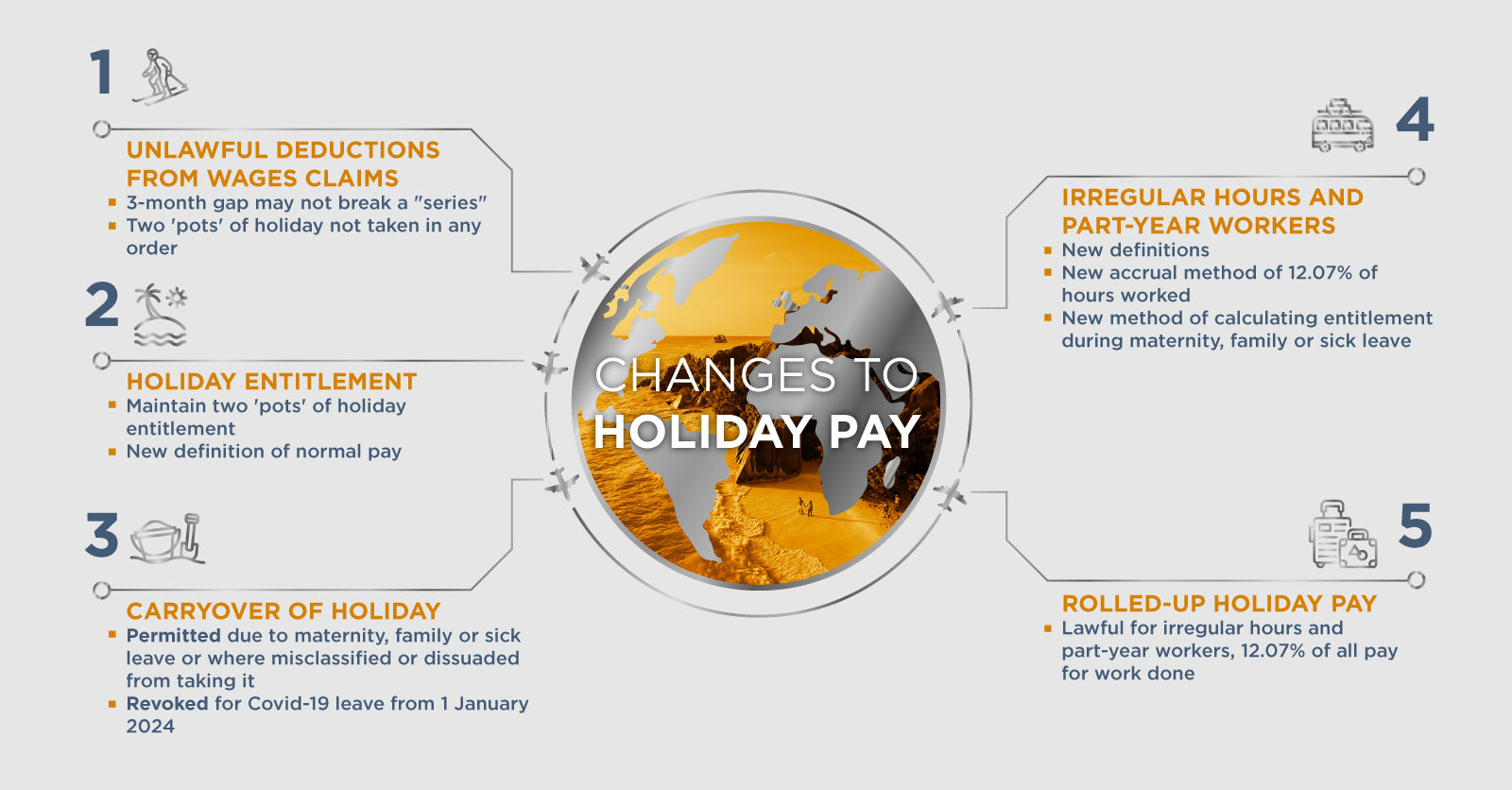
With such a lot to keep up with, our infographic summarises the 5 key changes to holiday pay for employers, with more detail below.
Background
Earlier this year, the Government consulted about the best way to calculate holiday entitlement for part-year and irregular hour workers. This followed the Supreme Court's ruling in Harpur Trust v Brazel, [2022] UKSC that holiday pay should not be pro-rated for part-year workers and that workers or employees on permanent contracts who only work for part of the year are entitled to 5.6 weeks' paid holiday per year, just like workers or employees who work all year (see our article here).
The Government also consulted on areas of retained EU employment law, one of which was simplifying annual leave and holiday pay calculations to ensure they are tailored to the needs of the UK economy and help create conditions for growth.
On 7 November 2023, the Government responded to both consultations in the same response and laid new draft regulations before Parliament, due to come into force on 1 January 2024.
5 Key Changes for Employers:
Unlawful deductions from wages claims
Two 'pots' of holiday entitlement maintained and defining 'normal pay'
(all employees and workers from 1 January 2024)
The government has decided not to create a single annual leave entitlement of 5.6 weeks for all workers, but to maintain two separate 'pots' of holiday entitlement with separate rates of pay.
Workers will continue to receive 4 weeks of holiday at 'normal' pay (referred to as Annual Leave) and 1.6 weeks of holiday that can be paid at basic pay (referred to as Additional Leave).
The Regulations define payments for Annual Leave as including:
- Payments, including commission payments, intrinsically linked to the performance of tasks which a worker is contractually obliged to carry out;
- Payments for professional or personal status relating to length of service, seniority or professional qualifications; and
- Payments, such as overtime payments, which have been regularly paid to a worker in the 52 weeks preceding the calculation.
However, whether non-contractual commission, or discretionary bonuses should be included is not addressed in the Regulations, nor is the meaning of 'regularly' in relation to overtime payments.
Carryover of holiday
(all employees and workers from 1 January 2024)
The Regulations confirm when holiday can be carried over. Irregular and part-year workers can carry over their accrued annual leave in the following circumstances, subject to the time limits detailed below. For all other workers and employees, carry over in the following circumstances is generally limited to Annual Leave apart from family-related absence where this also includes Additional Leave.
- Up to 4 weeks of Annual Leave can be carried forward where an employer fails to recognise or pay Annual Leave, such as where workers are misclassified, not encouraged or given an opportunity to take Annual Leave or not warned about needing to "use it or lose it". The right to carryover lasts until the end of the first full year in which the employer is no longer at fault.
- Up to 5.6 weeks (i.e. Annual Leave and Additional Leave) not taken due to family-related absence can be carried forward until the end of the next holiday year.
- Up to 4 weeks' Annual Leave not taken due to sickness absence can be carried forward but must be used within 18 months of the end of the holiday year in which it accrued.
- From 1 January 2024, workers will no longer be able to carry forward any Annual Leave for Covid-19, although Covid-19 holiday accrued before 1 January 2024 can be taken on or before 31st March 2024.
Irregular hours and part-year workers
(irregular and part-year workers with holidays years beginning on or after 1 April 2024)
- Part-year workers are defined as those only required to work part of the year under the terms of their contract, with periods within that year (during the term of the contract) of at least a week where they are not required to work and are not paid. This captures seasonal workers and some term-time only workers.
- Irregular hours workers are those whose number of paid hours worked in each pay period during the term of their contract in that holiday year are, under the terms of their contract, wholly or mostly variable. As well as capturing most zero hours workers and some agency and variable hour workers, this may capture a wider pool of workers if hours are "mostly variable" under the terms of their contract.
- A new accrual method calculates holiday entitlement at 12.07% of hours worked in a pay period in the first year of employment and beyond, accrued at the end of each pay period and subject to a total cap of 28 days of holiday each year.
- A new method for calculating entitlement during sickness or family-related absence requires entitlement to be calculated as 12.07% of the average weekly working hours in the 52-week period before the absence.
Rolled-up holiday pay
(irregular and part-year workers with holidays years beginning on or after 1 April 2024)
Employers will be allowed to pay "rolled up holiday pay" (providing holiday pay at the same time as basic pay) to part-year and irregular hours workers, where it is calculated on the basis of 12.07% of all pay for work done in a pay period, paid at the same time as the worker is paid for the work done and itemised separately on the worker’s payslip. Moving to rolled-up holiday pay is likely to require a change to workers’ contract terms. Employers will also need to ensure workers still take at least 5.6 weeks off work.
What should you do now?
Calculating holiday pay has always been complicated, and whilst the Regulations are welcome and provide some clarity, questions still remain. Whether the Government will have time to amend the draft Regulations to address some of these uncertainties before they come into force in January 2024 is unclear. In the meantime, we suggest taking the following steps to assess the impact on your business.
- Check your holiday year – when does this run? The changes relating to irregular and part-year workers will apply to holiday years beginning on or after 1 April 2024, which means that they will take effect at different times for different employers. For example, they will be effective from 1 January 2025 for employers who base their holiday year on the calendar year.
- Analyse your irregular hours and part-year workers. Who will be caught by the new definition of irregular hours or part-year workers? If you want to pay rolled-up holiday pay for these workers, changes to their contracts will be required. Also, the method of accruing holiday in hours at the end of each pay period for irregular and part-year workers means that you will have to decide how to handle requests to take more holiday than has been accrued at any given point in the year, as well as how these workers will be able to take their holiday that only accrues on the last day of the 12th pay period of the holiday year, given that it has to be taken in the same holiday year.
- Review your contracts, policies and procedures. Do they need amending to comply with the new rules? Are you capturing overtime, commission and allowance payments in at least 4 weeks of holiday pay? To head off carryover requests, ensure that you are reminding workers to use their holiday entitlement and that you are giving them enough opportunity to take it.