(8 min read)
Read this edition of our Paris International Arbitration Newsletter – September 2026 for hands-on insights from our practice for in-house counsels and practitioners.
Read this edition of our Paris International Arbitration Newsletter – September 2026 for hands-on insights from our practice for in-house counsels and practitioners.
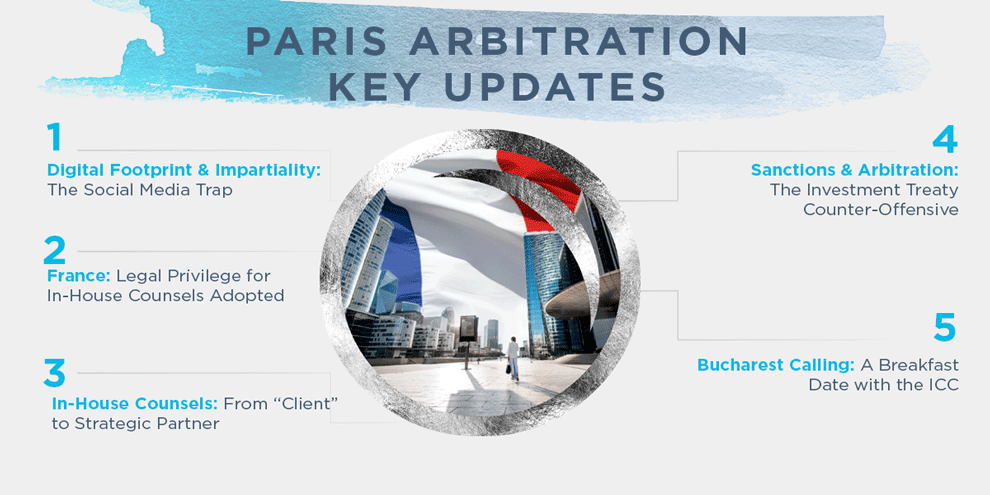
Welcome to our latest update, focused on bringing you closer to the pulse of arbitration in Paris. In this edition we have curated key arbitration points that we believe are important for you:
The Paris Court of Appeal addressed this very practical question in its decision of 28 July 2026, examining the due process ground raised against a DIAC award in an enforcement procedure.
Mr [U] and Mr [J], 50/50 shareholders of a Dubai logistics company, entered into a management dispute that went to DIAC arbitration. The arbitral tribunal ordered [U] to pay roughly AED 16.26 million; the first instance tribunal granted exequatur, [U] appealed the exequatur on several grounds, including a breach of the adversarial principle.
Mr [U] argued the arbitral tribunal breached the adversarial principle on two counts: he was barred from attending his brother's witness examination, and witnesses testified without taking an oath.
On the exclusion, the Court held that simply asserting exclusion is not enough. The appellant had to show he was deprived of adversarial debate and it was neither argued nor shown that the testimony he could not attend was not later discussed and challenged by him and his counsel (§86-87). The Court noted the exclusion followed UAE evidence law and was, in any event, already set out in the Terms of Reference; Mr [U] was represented by counsel throughout, without ever arguing his lawyer was prevented from exercising his rights.
On the oath, the Court first noted the appellant did not even specify which witnesses were concerned. In any event, the absence of an oath is a formality that carries no automatic consequence for the adversarial character of the debate, and the appellant showed no concrete prejudice to equality of arms.
Takeaway? A due process violation requires more than pointing to a departure from an idealised adversarial model, the challenging party must show concrete prejudice and that the missing safeguard actually deprived them of the ability to test the evidence or argue their case.
A useful contrast: Blow Pack v. Windmölller & Hölscher (CA Paris, 2 April 2013), where the tribunal let one party produce only partially translated documents, while opposing counsel didn't speak the language and the tribunal's president then personally translated the remaining excerpts himself, with the award relying 𝘦𝘹𝘤𝘭𝘶𝘴𝘪𝘷𝘦𝘭𝘺 on that self-translated material. The Court partially annulled the award, finding both that the tribunal failed to ensure equal footing between the parties, and that it based its decision on elements that had never been the subject of adversarial debate at all.
Read my analysis of the Cour de cassation’s decision here >
The latest edition of The ICSID Caseload – Statistics, published on 14 August 2026 and covering fiscal year 2026 (1 July 2025 to 30 June 2026) provides a snapshot of the regions generating the most investment disputes and the sectors concerned. The data points to a notable concentration of new cases in resource-intensive sectors, while the geographic distribution highlights the increasingly global nature of investment arbitration.
South America remains the leading region for newly registered cases. States in the region were involved in 22% of cases registered in FY2026, followed by Eastern Europe, Central Asia and Sub-Saharan Africa, each accounting for 20%. Together, these three regions represented more than 60% of the new ICSID cases.
The increase in Eastern Europe and Central Asia is particularly notable: the regions share rose from 12% in FY2025 to 20% in FY2026. By contrast, Sub-Saharan Africa's share decreased from 24% to 20%.
The picture changes when looking at the origin of investors rather than the location of respondent States. Investors from Western Europe accounted for 45% of investors involved in new cases, despite Western European States accounting for only 13% of respondent States. Similarly, investors from South and East Asia and the Pacific represented 14% of investors, while States from that region accounted for just 3% of new cases.
The sectoral distribution is perhaps even more striking. Oil & Gas alone accounted for 25% of cases registered in FY2026, making it by far the largest economic sector represented in new cases. Mining followed at 18%. Taken together, these two sectors accounted for 43% of all ICSID cases registered during the year.
The prominence of extractive industries is not new to investment arbitration. Such investments tend to be capital-intensive, long-term and particularly exposed to changes in regulatory frameworks, licensing arrangements, taxation and public policy. They are also frequently located in jurisdictions where natural resources constitute a significant part of the economy. The strong representation of Oil & Gas and Mining in the FY2026 caseload therefore provides an interesting link between the sectoral and regional dimensions of investment arbitration.
What does this tell us about the current investment arbitration landscape? The FY2026 data suggests that investment arbitration continues to be closely connected to sectors where foreign investment is both substantial and highly exposed to State intervention. Energy and natural resources remain at the forefront, but the broader caseload demonstrates that investment disputes increasingly arise across a diverse range of economic activities.
When an arbitration escalates to Board level, the questions are rarely about procedural points. Directors want to understand the commercial exposure, timing and strategic options. General Counsel should therefore be ready to answer five questions.
Whether the company is bringing or defending the claim, the Board will want a clear assessment of the financial stakes of the arbitration.
This means looking beyond the headline amount in dispute and assessing the range of realistic outcomes, including the principal amount, interest, potential counterclaims or set-off, and arbitration costs.
The objective is to give the Board a clear picture of what the arbitration could ultimately cost or recover for the company, rather than simply reporting the amount claimed.
Boards will want to understand when the dispute is likely to be resolved and what could affect that timeline. A high-level procedural roadmap — including jurisdictional challenges, document production, hearings, the award and any potential challenges or enforcement proceedings — can help set realistic expectations.
The budget should tell the whole story. In addition to external counsel’s fees, consider tribunal and institutional costs, experts, local counsel, document management and potential enforcement costs.
For a significant dispute, the Board should also understand how costs may evolve depending on the procedural strategy adopted.
Settlement should not necessarily be viewed as an admission of weakness. It is important to identify the potential settlement windows and understand what each side needs to achieve commercially. A settlement may become particularly attractive when compared against the expected cost, duration and uncertainty of continuing the arbitration.
Winning the arbitration is only part of the story. The Board should understand where the counterparty’s assets are located, whether they are readily enforceable against, and whether there are any practical obstacles to enforcement. Enforcement strategy should therefore be considered alongside the merits from an early stage, rather than after the award has been rendered.
The digital economy is generating increasingly novel disputes involving blockchain, smart contracts, digital assets and, more recently, transactions conducted by artificial intelligence agents. Arbitration institutions are beginning to adapt to this rapidly evolving landscape.
On 29 July 2026, the American Arbitration Association (AAA) launched a dedicated Web3 Panel, comprising arbitrators with expertise in disputes involving smart contracts, blockchain, digital assets, tokenisation, decentralised systems and autonomous transactions. The AAA's initiative reflects the emergence of disputes combining familiar commercial questions with highly technical subject matters.
The development is particularly relevant to arbitration. Digital transactions are frequently cross-border and may involve parties, assets and infrastructure spanning multiple jurisdictions. Arbitration can offer procedural flexibility and allow parties to appoint decision-makers with both legal and technical expertise.
At the same time, technology is testing some of arbitration's traditional assumptions. How is consent to arbitration established where a transaction is concluded through a smart contract? Which law governs a transaction carried out on a decentralised network? And how can an arbitral tribunal grant effective relief where the relevant assets or transactions exist entirely in digital form?
The rise of “agentic commerce” presents an even more novel challenge. As AI agents become capable of negotiating and entering into contracts on behalf of businesses and individuals, questions arise as to how parties can establish what was agreed and whether the agent was authorised to agree to particular contractual terms, including an arbitration clause. On 24 June 2026, the AAA and its partners launched the Legal Context Protocol (LCP), an initiative designed to make the legal terms governing AI-agent transactions identifiable and verifiable.
For arbitration practitioners, this raises a particularly novel question: if an AI agent enters into a transaction autonomously, how is the parties' agreement to arbitrate established and evidenced?
On 29 September 2026, we will be hosting the ICC Arbitration Breakfast Romania in Bucharest, together with Sebastian Guțiu of Schoenherr, in our capacity as members of the ICC International Court of Arbitration for Romania.
The event will bring together members of the Romanian arbitration community, practitioners and in-house counsels, for an interactive discussion with representatives of the ICC International Court of Arbitration on the key changes introduced by the newly revised 2026 ICC Arbitration Rules and their practical implications for arbitration users.
We look forward to a morning of discussion, exchange and networking with colleagues from across the Romanian arbitration community. Registration link >
If you would like to hear more about the conference, or if the topic is of interest to you or your business, please do reach out!

Subscribe to receive legal insights and industry updates directly into your inbox
Sign up now