Welcome to our latest update, focused on bringing you closer to the pulse of arbitration in Paris. In this edition we have curated key arbitration points that we believe are important for you:
Enjoy the read! Please do get in touch if you have any feedback or questions.
Ioana
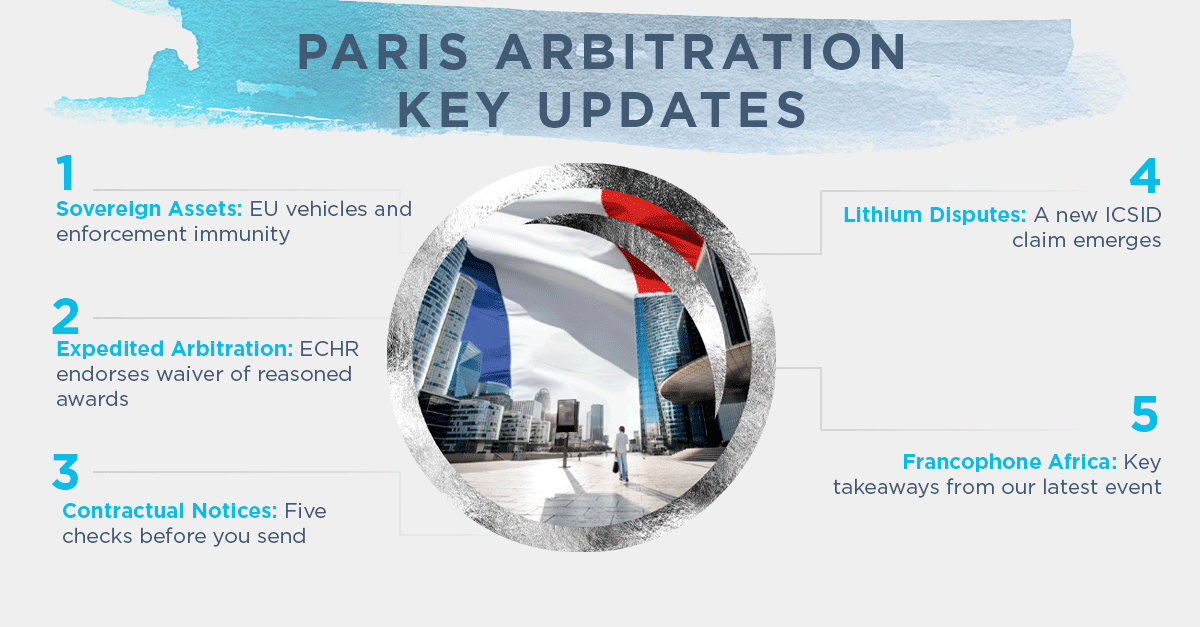
LATEST FRENCH ARBITRATION CASE LAW - A landmark ruling on how EU mandated asset vehicles can shield sovereign assets from arbitral enforcement
ENFORCEMENT AGAINST STATE‑LINKED VEHICLES & EU AID: On 17 June 2026, French Cour de cassation drew an EU‑law red line around the enforcement of arbitral awards against entities created to manage European financial assistance.
Hellenic Shipyards SA had an arbitral award against the Greek State, declared enforceable in France. To recover, it targeted the assets of Hellenic Corporation of Assets & Participations (HCAP) – a company created under Greek law to hold and monetise State assets transferred in the context of the European Stability Mechanism (ESM) programme. The Paris Court of Appeal authorised seizures over HCAP’s funds, treating HCAP as an “emanation” of Greece on the basis that it lacked genuine organic independence and did not have a truly separate patrimony.
On appeal, HCAP argued that this classic “emanation of the State” analysis could not be applied in a vacuum: the company’s very existence, structure and independence had been required by EU institutions as a condition of financial assistance, precisely to ring‑fence assets and ensure they served the objective of repaying European aid.
The Cour de cassation agreed that, in principle, assets of a legally distinct entity can be attached to satisfy a sovereign’s debts where the entity is not functionally independent, and its patrimony is effectively indistinguishable from that of the State. But it added an EU‑law override: this characterisation “must be set aside if it compromises the achievement of the objectives pursued by measures established by the European Union”. Because HCAP’s independence was a condition of the ESM programme, and its purpose was to monetise assets to reimburse European assistance, allowing State creditors to seize those assets in France would undermine those EU objectives. The Court therefore held that HCAP’s assets are immune from enforcement by creditors of the Greek State in France.
Takeaway? The French “emanation of the State” doctrine now has a clear EU‑law constraint: when a State‑linked vehicle is created to implement EU financial assistance and ring‑fence assets for that purpose, its object and EU‑mandated independence can trump veil‑piercing arguments and shield its assets from enforcement.
Read my analysis of the Cour de cassation’s decision here >
REGIONAL HIGHLIGHTS – Europe: ECHR upholds waiver of reasoned awards in expedited arbitration
The European Court of Human Rights (ECHR) has delivered a significant judgment for party autonomy in commercial arbitration. In a 9 June 2026 decision, the Court unanimously held that a party to an expedited arbitration in Finland had freely and validly waived its right to a reasoned decision, and that enforcing an unreasoned award did not breach the right to a fair trial under Article 6 of the European Convention on Human Rights.
- Voluntary commercial arbitration = space for waiver: The dispute arose from six contracts for rail tunnel repair between Jiitee Työt Oy (a Finnish excavation and rock construction company) and another Finnish company, M, each containing a Finland Arbitration Institute (FAI) arbitration clause with a sole arbitrator. The Court stressed that this was a voluntary commercial arbitration where certain Article 6 guarantees can be waived, provided the waiver is free, lawful and unequivocal.
- Express agreement to an unreasoned award: When M commenced arbitration under the FAI expedited rules in 2022, Jiitee Työt agreed to use those rules. At a case management conference, both parties – represented by counsel – expressly stated that the award did not need to contain reasons. The arbitrator then invited them, within a set time limit, to indicate if they nevertheless wanted a reasoned award; neither party responded.
- Unreasoned award, then a public policy challenge: In December 2022, the sole arbitrator rendered an award ordering Jiitee Työt to pay c. €330,000 plus interest for unpaid invoices, without any statement of facts or legal reasoning. Jiitee Työt sought to have the award declared null and void before the Helsinki District Court on public policy grounds, arguing that the FAI rules allowing unreasoned awards violated the Finnish Constitution.
- Finnish courts back party autonomy: The Helsinki District Court rejected the application, holding that Finland’s Arbitration Act does not require arbitral awards to be reasoned where the parties have agreed otherwise, emphasising that Jiitee Työt had twice agreed to an unreasoned award and failed to use its option under FAI rules to later request reasons. The Court of Appeal upheld the decision, and the Supreme Court refused leave to appeal.
- Article 6 challenge before the ECHR: Jiitee Työt then complained to Strasbourg that the Finnish courts had breached its right to a fair trial under Article 6 ECHR. It argued that the obligation to provide reasons is central to Article 6 – enabling parties to understand the decision and allowing courts to verify that key issues were properly considered – and that speed and finality in arbitration could not justify an entirely unreasoned award.
- Waiver must be free, lawful and unequivocal – and was: The ECHR reiterated that in voluntary commercial arbitration, parties may waive certain Article 6 rights if the waiver is (i) free, (ii) lawful and (iii) unequivocal, and contains certain minimum guarantees. It held that Jiitee Työt had validly waived its right to a reasoned award on at least three occasions.
- ECHR: reasons are optional if clearly waived: Parties who opt into expedited arbitration and expressly accept unreasoned awards will find it difficult to later invoke Article 6 to undo that choice. For commercial actors, this decision confirms that the trade-off between speed/finality and a fully reasoned award is compatible with the Convention – as long as the waiver of reasons is free, lawful, and unequivocal.
- ECHR Waiver Decision and the 2026 ICC Rules: That reasoning sits squarely behind the new 2026 ICC’s Highly Expedited Arbitration Provisions: a sole arbitrator, documents‑only procedure, tight three‑month award deadline and even the possibility of dispensing with reasons are all premised on clear, informed party consent (see Article 7(2)) of Appendix VI. For parties opting in under New Article 33 and Appendix VI, the Strasbourg judgment offers reassurance that trading detailed reasoning and fuller evidential processes for speed and finality is compatible with the European Convention on Human Rights, so long as the waiver is free, lawful, and unequivocal.
PRACTICAL TIPS – Before sending a contractual notice, ask yourself these questions
A contractual notice can preserve valuable rights—or inadvertently jeopardise them. Before pressing “send”, consider the following:
- Does the contract actually require a notice? Not every issue triggers a contractual notice obligation. Identify whether the contract requires notice for the event in question and understand the consequences of failing to comply. Some contracts distinguish between notices that are mandatory and those that are merely good practice.
- Am I sending it to the correct recipient? Many contracts specify exactly who must receive notices. Sending a notice to the project manager instead of the contractual representative, for example, may not satisfy the contractual requirements, regardless of whether the right person was informally aware of the issue.
- Am I still within the applicable time limit? Notice provisions often impose strict deadlines, and the consequences of missing them can be severe. Under certain standard form contract (such as FIDIC), failure to give timely notice can result in the complete forfeiture of an otherwise valid claim.
- Have I complied with the contractual formalities? Check whether the contract prescribes a particular method of service, form, language or content. With respect to content, it should be noted that many dispute resolution clauses go further and require the parties to set out, with precision, the points of agreement and disagreement before escalating the dispute to the agreed forum. Procedural non-compliance is not merely a technicality: in arbitration, a non-compliant notice can render an entire claim inadmissible, even where the underlying merits are strong. Arbitral tribunals applying a strict compliance standard have dismissed claims on this basis alone.
- Can I prove that the notice was sent and received? Retain evidence of transmission and, where possible, receipt. In arbitration, the ability to prove compliance with contractual notice provisions can be just as important as the notice itself.
A well-drafted notice is only effective if it complies with the contractual requirements governing when, how and to whom it must be sent. These five questions are worth asking not just before sending a notice, but before signing a contract. Understanding your notice obligations at the drafting stage, and negotiating them where possible, is the most effective way to avoid disputes down the line.
SECTORIAL NEWS – Lithium at the centre of a new wave of investment arbitration
The recent registration of an ICSID claim by Jupiter Lithium against Nigeria underscores the growing tensions between resource nationalism, regulatory enforcement, and investor protections in the energy transition sector.
A UK-based mining company, Jupiter Lithium, has initiated arbitration proceedings under the UK–Nigeria bilateral investment treaty (BIT), following Nigeria’s revocation of several mining leases tied to a major lithium project. The dispute highlights the increasing prominence of critical minerals projects in investment arbitration and the legal risks associated with evolving regulatory frameworks in resource-rich jurisdictions.
Jupiter’s claim arises out of a large-scale lithium development project in Kaduna State, reportedly valued at approximately US$2.5 billion. The project, which involved joint venture arrangements and downstream processing ambitions, was positioned as a strategic contribution to Nigeria’s transition to cleaner energy and global battery supply chains. However, the relationship deteriorated sharply after Nigerian authorities revoked key licences, citing alleged non-payment of statutory fees.
Against this backdrop, several key arbitration themes emerge:
- Regulatory enforcement versus treaty protection: This case illustrates the recurring tension between a host state’s sovereign right to regulate its natural resources and its obligations under investment treaties. While Nigeria appears to justify its actions on the basis of statutory non-compliance and sector reform, Jupiter contends that the revocations were unlawful and inconsistent with BIT protections.
- Critical minerals as a new frontier for disputes: Lithium and other energy-transition minerals are increasingly at the centre of high-value investment disputes. For instance, Tanzania has recently revoked approximately 40 mining licenses, citing non compliance with development timeline obligations. Historically, a large proportion of investment treaty cases have involved oil, gas, and mining projects—so it’s natural that lithium and “critical minerals” follow the same path. With the energy transition, these resources are now considered strategic assets by states, similar to oil and gas in past decades. In this context, many states are (i) tightening licensing regimes, (ii) increasing local content requirements (e.g., use local supplier or contracts), and/or (iii) renegotiating or cancelling concessions.
- Compliance disputes as a starting point: Nigeria’s allegation that Jupiter failed to pay approximately 2.5 billion naira in statutory fees highlights how relatively routine compliance issues can escalate into full-scale investment treaty disputes when licence revocations follow.
- Broader political and enforcement context: The dispute also arises amid Nigeria’s intensified efforts to combat illegal mining and reform its extractive sector. Such enforcement campaigns, while legitimate in principle, can create friction with foreign investors where measures are perceived as inconsistent, selective, or insufficiently transparent.
The case will likely be closely watched, not only for its substantive outcome, but also for its treatment of issues at the intersection of energy transition investments and host-state regulatory sovereignty. As jurisdictions recalibrate their approach to critical minerals, this arbitration serves as a reminder of the importance of aligning domestic policy objectives with international investment obligations.
BY THE WAY
By the way, on 23 June 2026, we hosted a particularly exciting event at AG for our clients: our conference on “Francophone Africa: Opportunities and Strategies”, where we had the great honour of welcoming Éléonore Caroit, Minister Delegate for Francophonie, International Partnerships and French Nationals Abroad, as our keynote speaker.
She was joined by Benoit Chervalier (Founding President at BCH INVEST, Vice-President Africa at MEDEF International in charge of European Affairs, Chairman Africa Network at Business Europe and author of the widely acclaimed “Ce qu’attend l’Affrique – Ressources locales, tensions mondiales”) and Matthias de Larminat, Managing Director of Vivo Energy Morocco.
Benoit Chevalier’s book provided an excellent basis for discussion. Expertly moderated by partner Jacques Dabreteau and myself, the session explored the key outcomes of the Africa Forward Summit, the impact of current geopolitical shifts on the African continent, and the main sectors, financing tools and growth drivers shaping the future of Francophone Africa.
If you would like to hear more about the conference, or if the topic is of interest to you or your business, please do reach out!