Change and challenges to come
Welcome to this month's edition of Employment To The Point. If you're responsible for Health & Safety, please note this month's cartoon is only for fun, we're not suggesting that's a safe system of work! If you're responsible for HR, then the cartoon is pretty much to scale…. look away now if you don't like change.
We know in broad terms what will be introduced. We just don't know the detail, timings and/or in what order. So, how will some of this stuff work?
Unfair dismissal becomes a day one right but there are reports of that being watered down during an initial six-month probationary period. Well-intentioned no doubt, but does that create the risk of satellite litigation around probationary period dismissals if some process must be followed? Similarly well-intentioned but pretty disastrous - does anyone remember when the last Labour Government thought statutory dismissal and grievance procedures were a good idea?
How do you ban fire and rehire – will the legislation remove an employer's right to give lawful notice to terminate an employment contract in some circumstances? On that topic see a report on the Supreme Court's views in the Tesco/USDAW case below.
Confused? All explained at our series of breakfast seminars this month – invite link below.
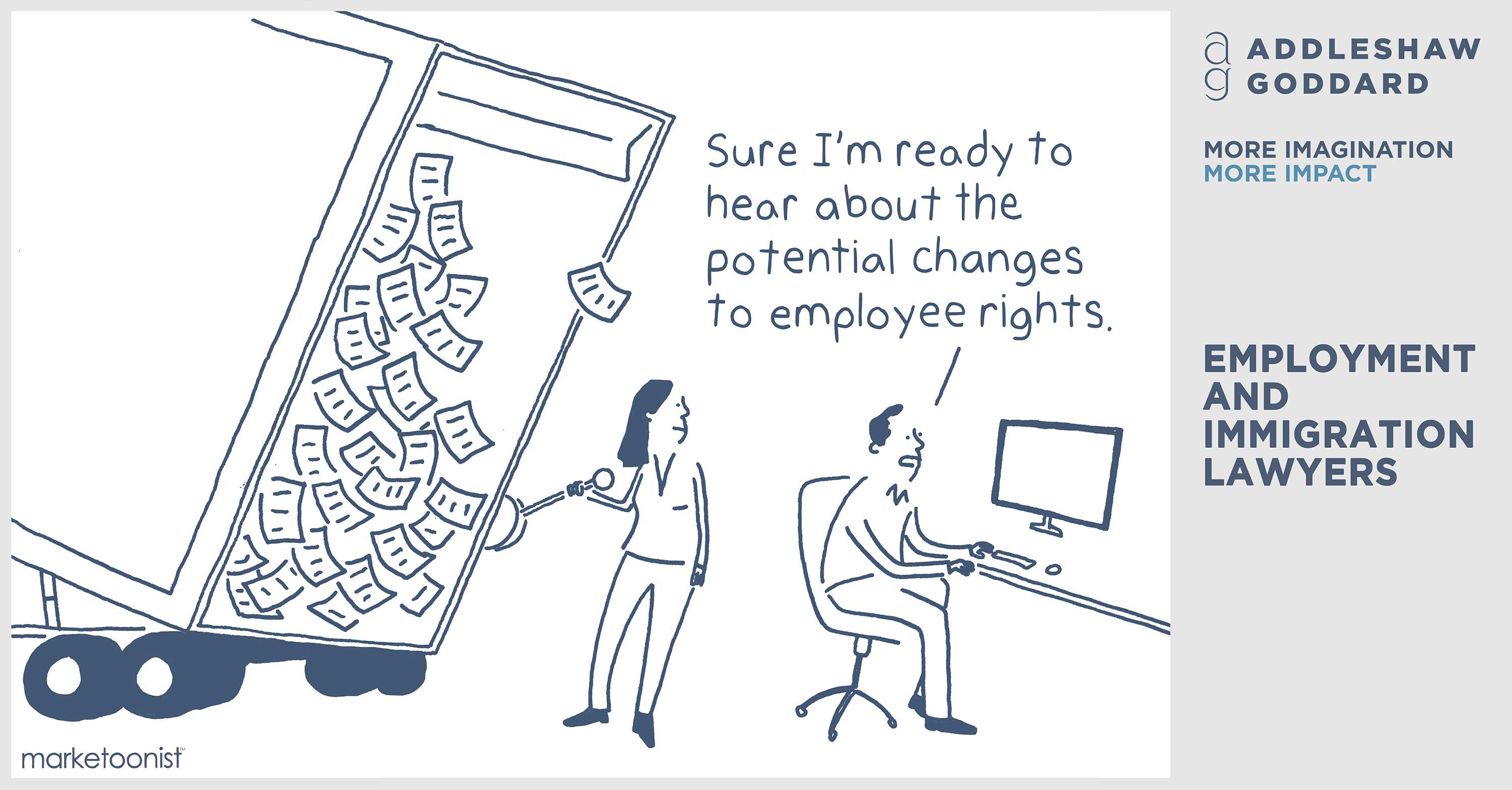
Editorial - by Micahel Burns
UK Supreme Court restores injunction preventing fire and re-hire
The Supreme Court has restored the injunction restraining dismissal and re-engagement on revised terms of Tesco employees. Find out what it means for employers here.
Collective bargaining and unlawful inducement – a defence for well-intentioned UK employers
We examine a recent case which shines a light on a possible defence for employers to claims for unlawful inducement under s145B TULRCA. Find out more here.
UK Business Immigration Update: Home Office moves towards eVisas and recommends keeping expired BRP cards
UK Visas and Immigration has just published updated guidance on eVisas. Read about the latest developments here.
UK Business Immigration and the Labour Government – what we know so far?
This article takes a look at the immigration reforms so far and what they will mean for employers. Read about the developments here.
International Update: Cracking the code: UAE Labour Courts explained
Our comprehensive guide to the litigation process in the UAE sheds light on the critical steps employers must take to safeguard their interests. From initial claims to final judgments, this article provides guidance on the court process, the common pitfalls and best practices in the UAE Labour Courts. Find out more here.
What else you should know
Flexible Working and Four-Day Week
There has been recent media coverage over a four-day working week with the suggestion from the Government that workers may be able to request to work compressed hours over four days instead of five. We do not yet have further details, but one of the Government's proposals in its Plan to Make Work Pay is to make flexible working the default from day one for all workers, except where it is not reasonably feasible. We are expecting this proposal to be taken forward in the forthcoming Employment Rights Bill.
Employees already have the right to request flexible working in the UK, which includes requesting a four-day week and working compressed hours. It is not yet clear what the new Bill will entail. One possibility is that the Government will make it harder for employers to refuse a request, as it is currently relatively easy for them to do so. The Government has said that there will be consultation on any changes to employment legislation as it wants to work in partnership with business.
Right to Switch Off
The Government has commented on its proposal to introduce a new "right to switch off" suggesting that it could be introduced through a code of practice similar to the ACAS code of practice on disciplinary and grievance procedures. A new code of practice would not create its own compensation claim but could mean that workers who are repeatedly contacted outside normal working hours may be able to claim uplifted compensation when bringing certain claims.
Reports suggest the Government plans would not be a "one size fits all", but policies would be developed specific to each workplace through agreement between a business and its workforce. The Government also recognises that the new right would have a disproportionate impact on smaller businesses and it is still considering a range of approaches. Further details of proposals will be available in due course.
Consultation on EHRC Technical Guidance on Sexual Harassment in the Workplace
The Equality and Human Rights Commission's consultation on its updated Technical Guidance on sexual harassment and harassment at work closed on 6 August 2024 and we await the final version to be published. The guidance has been updated to take into account the new duty on employers to take reasonable steps to prevent sexual harassment of their workers which comes into force on 26 October 2024.
Key takeaways:
- Employers should not wait for sexual harassment to happen before taking action.
- They should anticipate scenarios where employees may be subject to sexual harassment and take reasonable steps to prevent it.
- Where sexual harassment has occurred, steps should be taken to stop it happening again.
- It also makes clear that the preventative duty requires employers to take reasonable steps to prevent sexual harassment of workers by third parties, such as clients and customers.
- Employers are not directly liable for the harassment by third parties, but where they do not comply with the preventative duty, the EHRC has the power to take enforcement action against the employer.
Day One Unfair Dismissal Right and Probationary Periods
There have been media reports that in a compromise to the Government's election pledge to give employees day one protection from unfair dismissal, employers will be able to put new employees on probation for up to six months. The Government has previously indicated that it will introduce probationary periods with "fair and transparent rules and processes" to enable employers to assess new hires. No further details have been published yet, but we expect to see something in the forthcoming Employment Rights Bill.
Harnessing Generative AI: A Practical Legal Guide - In our practical legal guide to harnessing GenAI solutions we identify some key topics to be thinking about now, the key areas of risk and how to mitigate them. Download a copy here.
For all the latest legislative developments and forthcoming cases in employment law see our latest Horizon Scanner by visiting our website page here.
Upcoming Events:
Our Autumn HR Seminars will be taking place in our Manchester office on Wednesday, 2 October 2024, our London office on Tuesday, 15 October 2024 and our Leeds office on Thursday, 17 October 2024.
We will look at the Labour Government's extensive plans for changes to employment law in more detail and our expert speakers will guide you through what to expect in the short, medium and longer-term and what you can do now to prepare for these changes. It promises to be a very popular event and for more information, please visit the registration pages here for the Manchester event, the London event and the Leeds event.
For our Employment and Immigration Training Calendar 2024/25 listing all our client training events, please visit our website page here.