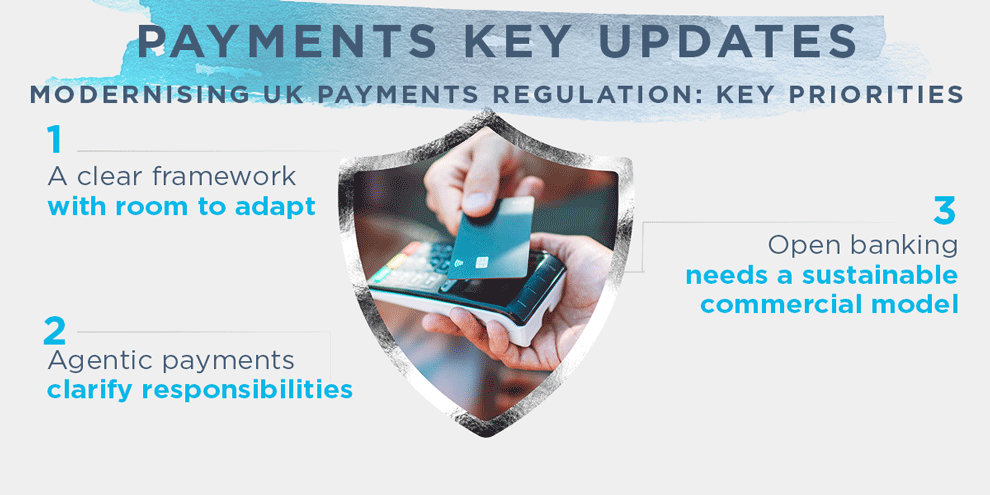
HM Treasury’s Modernising Payment Services Regulation consultation, published on 14 July 2026, considers how the UK framework should respond to a changing payments market. Five drivers underpin the review: fragmentation and overlap between the existing regimes; new forms of digital money; the need for Strong Customer Authentication (SCA) to evolve; a sustainable long-term Open Banking framework; and emerging risks across increasingly automated, multi-party payment journeys. The objective is a clearer and proportionate framework that accommodates innovation while maintaining consumer protection and market integrity.
A clearer framework, with room to adapt
The current Payment Services Regulations 2017 and Electronic Money Regulations 2011 require firms to navigate two regimes. Merging the frameworks would create one coherent set of rules, allow for the use of consistent definitions and simplify and streamline authorisation processes.
In addition, HMT are consulting on moving detailed technical and operational requirements out of static legislation and into the FCA rulebook. A payments ecosystem encompassing a range of different technologies that are changing at pace, such as innovations supporting account-to-account payments and programmable payments, needs a regulatory framework that is less rigid. Industry is now considering to what extent a technology-neutral, outcomes-based approach would provide greater flexibility and ensure good customer outcomes, but also the right amount of legal certainty for their businesses to operate.
Regulatory change programmes should be ready to track future FCA consultations and rule changes alongside legislative reform.
Agentic payments: clarify responsibilities
Agentic payments involve artificial intelligence (AI) agents making payment decisions on a customer’s behalf within delegated parameters, potentially choosing when to pay, whom to pay and which payment method to use. The resulting payment could use account-to-account, card or tokenised payment infrastructure. Policy clarification is needed on which activities fall within existing permissions or where the use of such technologies sits outside the payments perimeter.
The key question is whether, when an AI agent is used to initiate a payment, that activity is (1) treated as acting within the scope of a prior consent given by a payer or (2) treated as the AI agent exercising autonomous judgement as an agent of the principal. It is crucial that we have clarity on this so that the boundaries of responsibility can be drawn.
Consent and authentication are central to ensuring we have a regulatory framework that provides that legal certainty for all actors. In our view, a customer’s authority for an agent to choose what to buy and from whom needs to be distinguished from the authority for the initiation of subsequent payment transactions. The regulatory and contractual obligations for these different appointments should then be considered separately. For the latter, we need the payments regulatory framework to define exactly what delegated authority means and set clear boundaries for the scope of that delegation.
Liability needs equally careful treatment. Unauthorised payments, an agent exceeding its mandate, model defects and an unwanted purchase made within valid authority are different problems. A future framework could allocate responsibility by each participant’s role, information and control, rather than automatically placing every loss with the account provider.
Secure, permissioned interfaces and possible “Know Your Agent” or certification arrangements could help verify identity and authority and provide assurance that mandates are obtained appropriately. But the issue of liability when an AI agent acts outside of the mandate or interprets the instruction incorrectly needs to be resolved.
Digital money
The regulatory perimeter is expanding to integrate tokenised deposits and UK-issued or recognised qualifying stablecoins. The government is applying a "same risk, same regulatory outcome" principle. Once inside the Payment Services Regulations 2017 perimeter, tokenised payments are subject to standard execution rules. This includes SCA, transparency of fees, execution timelines, and liability rules for unauthorised transactions.
To prevent firms from needing two licences for the same transaction, qualifying payment stablecoins are carved out from certain cryptoasset intermediary rules under the Financial Services and Markets Act 2000 (FSMA). However, firms dealing with digital money or asset-backed instruments must evaluate how varying permissions apply so they do not get caught in dual-regulation traps.
Open Banking needs a sustainable commercial model
Open Banking reform centres on scaling account-to-account payments while funding reliable services. Commercial variable recurring payments (cVRPs) are a key use case, distinct from sweeping payments between a customer’s own accounts. A central policy choice is whether cVRP access should remain market-led or be supported by a new statutory right. Mandated access could improve coverage and competition but may impose disproportionate implementation costs and weaken incentives for voluntary investment.
Outside of cVRPs, in order for Open Banking to operate on a commercially sustainable model, the regulatory prohibition on account servicing payment service providers (ASPSPs) requiring payment initiation service providers (PISPs) to enter into agreements for data access needs to be reconsidered. This will then pave the way for commercial models. However, as we know, centralised pricing arrangements raise concerns about compliance with competition law. A long-term solution for the competition law risk is required if Open Banking schemes are to emerge and scale to become a viable alternative to existing payment methodologies.
Banks and third-party providers should be considering the cost and coverage of proposed access rights, application programming interface (API) service levels and commercial scheme terms, rather than assuming that all existing free-access obligations will simply carry over.
What should firms do now?
Firms should establish a coordinated process for monitoring the government’s response, future FCA consultations and supervisory expectations. Firms should also start considering how proposed reforms may affect their permissions, product strategy and customer-facing agreements, particularly for products involving digital money, agentic payments or new payment initiation models.