When trade unions come knocking
Since the introduction on 30 October 2026 of the right for trade unions to seek access to the workplace employers have faced an influx of requests. For some this has meant agreeing voluntary arrangements with unions they already recognise. For others this has meant engaging with trade unions for the first time, and a need to consider what they would like trade union relations in their business to look like in the future.
In addition, on 16 November 2026 we received the long-awaited guidance from the UK Government about the new obligation to inform workers of their right to join a trade union. This change means that all employers will be communicating about union membership, regardless of their size, sector or history of union engagement. The implications extend beyond the UK. For international employers with a group-wide industrial relations strategy, UK decisions on union access and workforce communications may have an impact across borders, influencing expectations and approaches elsewhere.
These changes mean that employers need a clear and coherent approach to access requests, worker communications and union engagement. This should reflect their business priorities and, where applicable, their wider international strategy. For more on this, do join us for our Industrial Relations webinar on 3 December, details below.
Editorial by Sarah Harrop
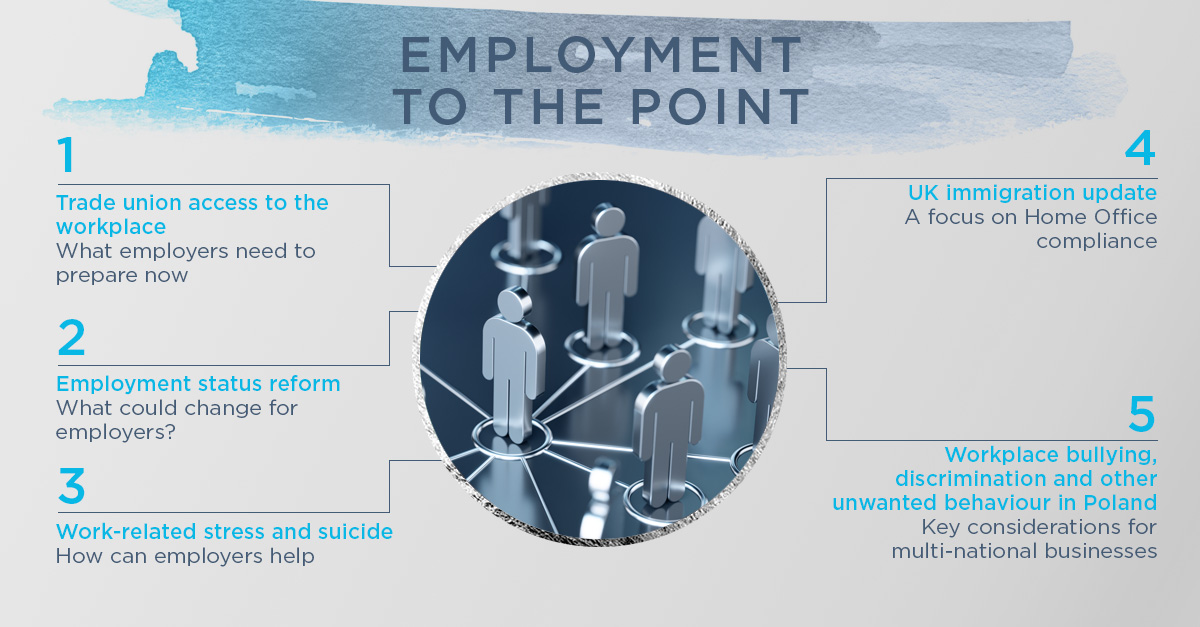
Trade union access: Why employers need to prepare now
Employers need to be ready to respond to new trade union requests to access to workplaces.
Find out how employers can prepare here.
Employment status reform: What could change for employers?
The government is consulting on significant changes to reform employment status.
Read about what it could mean for employers here.
Work-related stress and suicide: Managing the risks to your business
Employers need to look beyond wellbeing policies in tackling work-related stress. It is a health and safety risk and with growing scrutiny of potentially work-related suicides, we look at the steps employers can take to address mental ill-health.
Find out how employers can support staff here.
When the Home Office comes calling: Is your business ready?
We are seeing a significant increase in Home Office sponsor compliance requests and visits.
Read about how sponsors can prepare here.
Poland: Workplace bullying, discrimination and other unwanted behaviour in the workplace
We take a look at the new rules in Poland for preventing and addressing workplace bullying, discrimination and infringements of employees’ dignity which came into effect on 5 November 2026.
Find out more here.
Upcoming Events
We are holding an Industrial Relations webinar on the new trade union right to access the workplace at 13.00 – 13.45 on Thursday, 3 December 2026.
Our Industrial Relations team will be discussing what we are seeing in the market, how the new right is affecting businesses one month on, sharing insights on the approach unions are taking, how to handle requests and addressing some common concerns from clients. For further details and to register at your preferred venue, visit the registration page here.
For our Employment and Immigration Training Calendar 2026 listing all our client training events, please visit our website page here.
What else you should know
Informing workers of right to join a trade union - new standardised form and guidance published
Since our recent article on the duty to inform workers of right to join a trade union – What employers need to know, the government has now published the standardised statement for employers to inform workers of their right to join a trade union alongside guidance for employers. The guidance makes clear that employers must not add further information to, or change the statement, except in situations outlined in the guidance.
Pay Transparency in Job Adverts
The government has announced that it will legislate to introduce pay transparency in job adverts “as soon as possible”. There are no further details on the scope of the new legislation yet, but in the meantime, the government is calling on all businesses “to say what they pay on job ads now, rather than wait for the law to change.” Separately, the EHRC has published its response to the government consultation on equal pay and pay discrimination which sets out that "the EHRC believes that improving pay transparency, including requiring employers to publish salary information in job adverts and the introduction of a statutory pay questionnaire, can help avoid discrimination." The Competition and Markets Authority has also warned of the competition risks associated with pay disclosure in job adverts. We will keep you updated on any further developments.
Update on reform of non-compete clauses
The government has indicated that it will legislate to reform the use of non-compete clauses. We were hoping for further details in the Autumn Budget, but the government re-iterated its intention to legislate on non-compete clauses and gave no further indication of whether this means a complete ban or a curtailment of non-competes e.g. by introducing a salary threshold or making non-compete clauses time limited.
The government did confirm that it will consult shortly to understand the wider use of restrictive practices, to ensure action it takes is “proportionate, evidence-based and supportive of both dynamism and intellectual property”. The government will set out a detailed position on all of these issues in early 2027, ahead of bringing in legislation.
Consultation response on extending maternity protections
The government has published its response to the consultation on enhancing dismissal protections for pregnant women and new mothers which closed on 15 January 2026. Key points:
- New proportionality test during the protected period to replace the current band of reasonable responses test for unfair dismissal.
- Employers will need to justify dismissal as a proportionate means of achieving a legitimate aim, by identifying what business objective is being furthered by the decision to dismiss the employee and demonstrating that dismissal is a proportionate way of achieving that.
- This will ordinarily require an employer to be confident that less severe alternatives were not reasonably available in the circumstances (for example, temporary changes to a role, identifying suitable alternative roles).
- This is the legal test that an Employment Tribunal would apply when determining whether a dismissal was fair.
- Start of protection entitlement – A "day one" right with no qualifying period, meaning employees will qualify for protections from the first day of employment.
- Start of enhanced dismissal protection – trigger point - Protections will apply once an employee has informed their employer that they are pregnant.
- End of enhanced dismissal protection - Protections will apply throughout Maternity Leave and for 6 months following the end of leave.
- End of enhanced dismissal protection – where there is no Maternity Leave entitlement - Protections will last for 2 weeks following the end of a pregnancy where there is no entitlement to Maternity Leave.
- Other parents – Adoption Leave - Enhanced dismissal protections will also apply to Adoption Leave. Protections will apply during the period of leave and for 6 months following the end of leave.
- Other parents – Shared Parental Leave, Neonatal Care Leave and Bereaved Partner’s Paternity Leave - Enhanced dismissal protections will extend to Shared Parental Leave, Neonatal Care Leave and Bereaved Partner’s Paternity Leave. Protections will apply during the period of leave and for 6 months following the end of leave where 6 or more continuous weeks of leave is taken.
- Implementation and mitigation - The government does not intend to specify how the test should operate through regulations. Instead, it will provide guidance and support working with ACAS.
While this is going to mean greater operational challenges for employers with more complex HR processes, the government intention is to strengthen the existing test while maintaining flexibility to allow dismissal in appropriate circumstances. It will require broader efforts to identify suitable alternative roles and greater scrutiny on reasons for dismissal. It could also lead to a greater risk of perceived unfairness among employees. The alternative options of narrowing the fair reasons, would have been far more complex for businesses to navigate. Also, the government does recognise that the steps available to employers will vary depending on the size and nature of the organisation.
Widening scope for bereavement leave from April 2027
The Employment Rights Act 2025 is widening the scope of the current entitlement to parental bereavement leave to cover other bereavements, including pregnancy loss before 24 weeks. The government has now published its response to the consultation on bereavement leave setting out the details for the extended right:
- Eligibility: General bereavement leave will be a day one right to unpaid leave and will cover the death of spouses, partners (civil or in a committed long-term relationship), parents (including kinship and foster carers), adult children and siblings. Parental bereavement leave will be extended to cover all types of pregnancy loss before 24 weeks, including all types of miscarriage, IVF embryo transfer loss and terminations, and will be available to the pregnant person, the other parent or partner, an intended co-parent and the intended surrogate parents.
- When and how. Employees will be able to take up to two weeks' leave (pro rata) within 56 weeks of bereavement. It can be taken discontinuously in one day units, starting from the date of death, pregnancy loss, or date of knowledge to enable employees to take leave on important dates such as first anniversary.
- Notice and evidence requirements. Notice should be provided before the employee starts work on the day they intend to take leave, or as soon as reasonably practicable for the first eight weeks of bereavement. After the initial eight-week period, one week's notice should be given. Any form of notice will be acceptable and no evidence will be required.
The new entitlements are expected to come into force in April 2027 and the government has also indicated that it will publish guidance for employers and employees detailing their rights and responsibilities.
Fire and Re-hire - changes to expenses, benefits, and shift patterns
The government has published its response to the consultation on fire and re-hire - changes to expenses, benefits, and shift patterns. Key points include:
- Expenses and benefits - expenses and benefits to be included in scope of the restricted variations are certain types of travel expenses (including mileage), accommodation expenses and accommodation as a benefit in kind. Changes to share schemes will not be in scope of the restricted variation. This means that it would be automatically unfair to dismiss someone in order to vary a contractual term for sums payable in respect of travel expenses, accommodation expenses or accommodation as a benefit in kind.
- For other types of expenses and benefits that will not be in scope of the restricted variations, employees may rely on a range of protections to protect these terms from being altered by their employer. Enhanced unfair dismissal protections in the Employment Rights Act 2025 and the statutory Code of Practice on Dismissal and Re-engagement will require employers to engage meaningfully with employees and their representatives when seeking to vary contractual terms, with the potential for an uplift in compensation where the Code is not followed. In addition, existing statutory protections, including those under National Minimum Wage legislation and the Equality Act 2010, will continue to apply.
- Shift patterns - it would be automatically unfair to dismiss someone in order to make a change to contractual shift patterns which would mean:
- The employee is required to work in the nighttime where they were not required to before or is required to work in the daytime where they were not before.
- The employee is required to work on a weekend where they were not required to before or is required to work in on a weekday where they were not before.
- The government will not include availability windows in scope of the restricted variation for shift pattern changes. The restricted variation will be limited to changes to the period when employees are scheduled to work in a contract.
The government has also published a consultation on a new draft Code of Practice on Dismissal and Reengagement setting out best practice requirements including where employers should consult and give reasonable notice of changes to contracts to come into effect in Summer 2027. Failure to comply with the Code can lead to an uplift to the compensatory award by up to 25% in relevant unfair dismissal cases. In addition, the 2025 Act guarantees specific rights to reasonable notice of cancellation of or change to a shift.
The aim is for Regulations to come into force in March 2027 at the same time as the Employment Rights Act 2025 fire and re-hire protections. The government will also update its guidance.
Whistleblowing consultation published
The government has launched a consultation to seek views on the current whistleblowing framework. With the implementation of strong whistleblowing protections across Europe through the EU Whistleblowing Directive and the introduction of whistleblowing financial incentive schemes in the United States, the government is asking whether the existing framework in the UK is operating effectively and, if not, how it should be reformed. It is also seeking views on a proposal for the Serious Fraud Office to introduce a financial reward scheme for whistleblowers reporting economic crime. The consultation is wide-ranging looking at all aspects of the current framework and will close on 8 January 2027.
Updated Timeline for ERA reforms
The government has published a further updated timeline for the implementation of the ERA reforms. We now have a more defined timetable for reforms previously only listed as 2027. For further details, see our Employment Rights Act 2025 Tracker by visiting the resources section of our website page here.