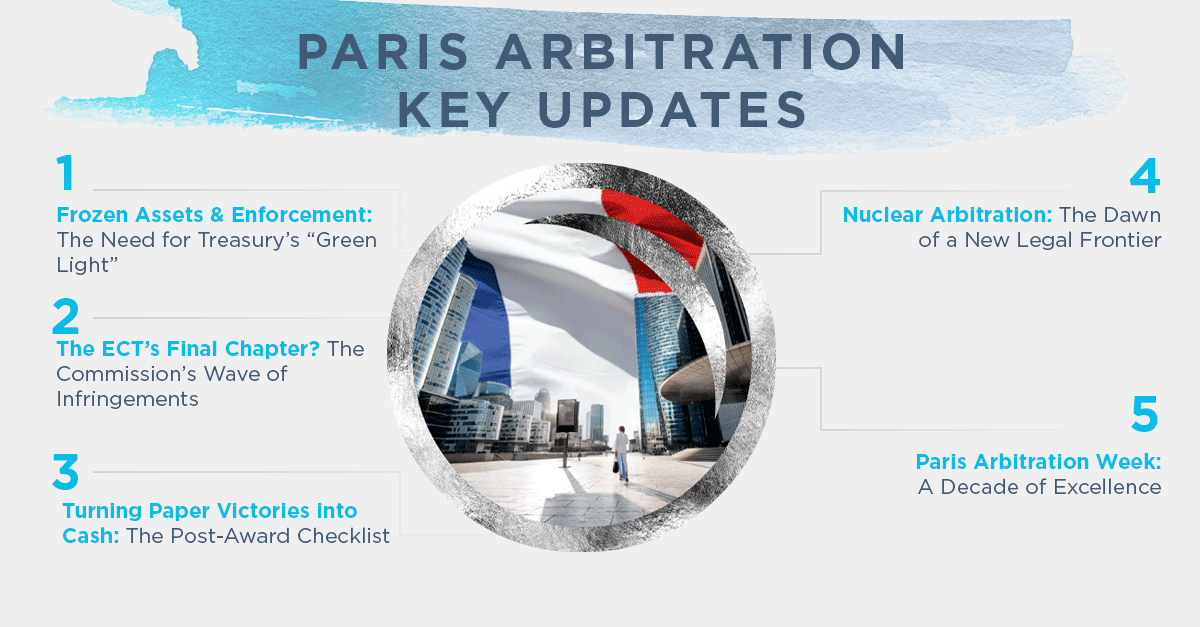
Welcome to our latest update, focused on bringing you closer to the pulse of arbitration in Paris. In this edition we have curated key arbitration points that we believe are important for you:
Enjoy the read! Please do get in touch if you have any feedback or questions.
Iona
Latest French arbitration case law
ENFORCEMENT, FROZEN ASSETS & THE LIMITS OF JUDICIAL POWER: On 5 February 2026, the French Court of Cassation delivered a ruling in Al-Kharafi v. LIA, offering a useful reminder of the hierarchy between EU sanctions law and national enforcement procedures when it comes to executing awards against frozen state assets.
The dispute arose from a $936M arbitral award obtained by Kuwaiti company Al-Kharafi against Libya. To recover its funds, Al-Kharafi targeted assets held by the Libyan Investment Authority – an entity listed under EU sanctions – and obtained an attachment before French courts, which the Paris Court of Appeal subsequently annulled. Before the Court of Cassation, Al-Kharafi argued that Treasury authorization was only required at the stage of actual payment – not attachment. The Court disagreed and, applying a strict four-step reasoning rooted in the primacy of EU law, it held that asset freezing affects the validity of the attachment itself, and that neither the court order nor the Sapin II judicial authorization could substitute for prior administrative clearance.
Takeaway? This ruling sends a clear message to award creditors: enforcing against frozen assets is not a “seize first, ask permission later” game. The Treasury’s authorization is a prerequisite for the validity of the enforcement measure itself – not a formality reserved for the payment stage.
(Read my analysis of the Court of Cassation’s decision here)
REGIONAL HIGHLIGHTS – EU: The Energy Charter Treaty’s final chapter?
The Energy Charter Treaty (ECT) is no stranger to controversy – but could 2026 mark the beginning of its end within the EU? On 30 January 2026, as part of its January infringement package, the European Commission sent letters of formal notice to 16 Member States that remain contracting parties to the ECT, following the EU and Euratom's own withdrawal from the Treaty on 28 June 2025. The Commission's message was unambiguous: withdraw “without undue delay”. This move carries significant implications:
- A constitutional ambush? The Commission’s move appears in contradiction with its own recent legislative history. Council Decision 2024/1638 of 30 May 2024 – which authorized the EU's withdrawal from the ECT – had indeed deliberately preserved political space for Member States to remain contracting parties, pending a separate Council decision that was explicitly anticipated but never adopted. It would seem that the Commission is now effectively using infringement proceedings to neutralize a Council decision that intentionally left the choice to Member States,
- The competence argument: The Commission’s legal theory rests on the EU’s exclusive competence over trade and investment under the TFEU. Its position is straightforward: following the EU’s withdrawal, Member States are no longer empowered by the EU to exercise this competence through the ECT and must therefore withdraw,
- Hungary's precedent: This is not uncharted territory. Separate infringement proceedings are already pending against Hungary over its inconsistent position on the ECT – and on 17 July 2025, the Commission referred Hungary to the CJEU. The January 2026 package now extends this pressure to fifteen additional Member States simultaneously, significantly raising the political stakes,
- Implications for arbitration: For practitioners and investors, the stakes are considerable. If the 16 Member States withdraw, the ECT's “sunset clause” – which preserves treaty protections for existing investments for 20 years post-withdrawal – will become the central battlefield. The wave of intra-EU ECT claims already pending before arbitral tribunals is unlikely to diminish: if anything, this latest escalation may accelerate the rush to file before the window narrows even further,
- Next steps: The Member States concerned (Austria, Belgium, Bulgaria, Croatia, Cyprus, Czechia, Estonia, Finland, Greece, Hungary, Ireland, Latvia, Malta, Romania, Slovakia and Sweden) now have two months to respond, failing which the Commission may issue a reasoned opinion – and ultimately refer non-compliant states to the CJEU.
PRACTICAL TIPS – Enforcing your arbitral award: the post-award checklist
Winning an arbitral award is only half the battle. The real test begins the moment the award is rendered: converting that hard-fought victory into actual payment. Yet enforcement is too often treated as an afterthought. The reality is starkly different. Enforcement is a strategic operation in its own right, requiring early preparation, cross-border coordination, and relentless commercial discipline. Here is your post-award checklist to turn paper victories into cash:
- Start before the award is rendered: The enforcement mindset must kick in well before the award is issued, as soon as the arbitration is envisaged. Start enquiring on the debtor’s asset profile – bank accounts, real estate, shareholdings, receivables – as early as possible. The element of surprise is one of your most powerful weapons: a debtor who sees enforcement coming will move assets. Do not give them that head start,
- Know your treaty landscape: The 1958 New York Convention – ratified by 157 countries – is your best friend. It requires signatory courts to recognize and enforce foreign arbitral awards with limited exceptions. Before filing for enforcement, verify that your target jurisdiction is a signatory, identify any reciprocity reservations, and anticipate local procedural requirements that may go beyond the Convention itself,
- Go multi-jurisdictional – and do it simultaneously: Enforcement is rarely a single-front operation. The New York Convention expressly permits concurrent enforcement proceedings in multiple jurisdictions. If the debtor has assets in three countries, consider launching in all three at once. Parallel proceedings not only maximize recovery prospects but also put significant pressure on the debtor,
- Convert the award into a judgment – fast: Arbitral awards are not self-executing. They must be converted into a national court judgment before you can touch the debtor’s assets. Be extra careful: the absence of a uniform approach to limitation periods for the enforcement of foreign arbitral awards requires heightened due diligence to ensure the enforceability of your awards,
- Sovereign debtors require a different playbook: If you are enforcing against a state or state-owned entity, sovereign immunity is the elephant in the room. Identify upfront which assets may qualify as “commercial” rather than “sovereign” – only commercial assets are typically available for execution. Check whether the debtor waived immunity in the arbitration clause (and how broadly), and anticipate that enforcement against central bank assets or diplomatic property will face near-insurmountable hurdles in most jurisdictions,
- Consider third-party funding for enforcement: If the enforcement battle promises to be lengthy and expensive – and the debtor is determined to resist – third-party funding is worth considering. Funders are increasingly active in the enforcement space, offering everything from financing legal fees to outright purchase of the award at a discount,
- Keep management in the loop, and set realistic expectations: Enforcement timelines are notoriously unpredictable, and leadership will want answers. Establish a clear internal reporting cadence, maintain updated financial reserves, and ensure that any settlement discussions – which often intensify post-award – are escalated promptly.
SECTORIAL NEWS – Nuclear energy & arbitration: the dawn of a new legal frontier
Nuclear energy is back! After decades of political hesitation and even retreat after Fukushima, the atom is doing a remarkable comeback – driven by climate imperatives, energy security anxieties, and the soaring power demands of the digital economy. With the International Atomic Energy Agency (IAEA) forecasting significant growth in installed nuclear capacity up to 2050, and 47% of industry respondents identifying the cost of nuclear projects as a most likely driver of disputes, nuclear arbitration is fast becoming one of the most complex – and consequential – frontiers in international dispute resolution:
- Two speeds, one sector: The contrast could not be starker. France’s programmation pluriannuelle de l’énergie (PPE 3), officially published on 12 February 2026, confirms six new EPR2 reactors – the most ambitious nuclear relaunch in Europe in a generation. Germany, meanwhile, completed its definitive phase-out in April 2023, having shuttered its last three reactors despite fierce debate over energy security and climate logic. Two states, two diametrically opposed policy choices – and, as the Vattenfall saga showed, both carrying significant legal exposure,
- The investment treaty playbook – Vattenfall v. Germany: Germany’s nuclear phase-out triggered the landmark ECT investment treaty claim by Swedish state-owned Vattenfall, which settled in March 2021 for €1.4 billion – with Germany paying a further €1 billion to domestic utilities to close all pending litigation. The case established that state-mandated nuclear phase-outs can constitute compensable investment treaty breaches, and has since become required reading for any state contemplating to reverse its nuclear policy,
- A sector unlike any other: Nuclear projects are uniquely prone to disputes – over ten years from conception to operation, costing tens of billions of dollars. The Olkiluoto 3 ICC arbitration ran for a decade before settling; the San Onofre ICC arbitration capped recovery at US$125 million against a US$7.57 billion claim. And these are only the cases we know about: most nuclear arbitrations remain confidential,
- The regulatory maze – arbitration’s silent third party: Nuclear construction operates under a two-track licensing regime, with “hold points” beyond which no work can proceed without approval from the regulator. Delayed approvals and the inability to work “at risk” are the most prolific sources of claims. For in-house counsel, regulatory conduct is not a background fact: it is a central element of the legal case,
- A new wave of disputes on the horizon: Two categories of disputes are emerging: (i) claims regarding the upgrade and revitalization on ageing infrastructures, and (ii) disputes concerning newly built construction. With China building 28 of the 61 nuclear power plants currently under construction around the world, and 15 small modular reactors (SMRs) expected online in the 2030s, an entirely new generation of disputes – around novel technology and first-of-a-kind designs – is on its way,
Nuclear energy is no longer a niche area of arbitration practice, it is becoming one of its defining frontiers.
BY THE WAY
If there is one gathering that never fails to remind me why I love this field, it is the Paris Arbitration Week – and this year, the “PAW” celebrates its 10th edition! A decade of bringing together the brightest minds in international arbitration, and the energy never gets old.
Together with my partners at Addleshaw Goddard, we are hosting what I hope will be one of the most candid conversations of the week: “Compliance & International Arbitration: What In-House Counsel Really Need to Know”. And yes, the title says it all. Because while in-house counsels are the backbone of every arbitration we handle, they are too often the unsung heroes of the PAW. This event is for them, and about them.
We will be diving into the hard questions: how compliance should be taken into consideration at the time of signature of the contract, during its performance and at its termination. Raw strategy, real scenarios, and a room where the audience is part of the debate.
Space is limited and registration is essential – so secure your spot quickly! I cannot wait to see you there, and to celebrate together a decade of PAW in the most fitting way: by asking the questions that really matter.